
Solar in Surrey: roof space, shading, appearance and planning.
Four things decide how solar works on a Surrey home: how much usable roof there is, how much shade falls on it, how the array will look, and what planning allows.
A roof assessment is free and binding on no one. Qualifying homes can use payment options.
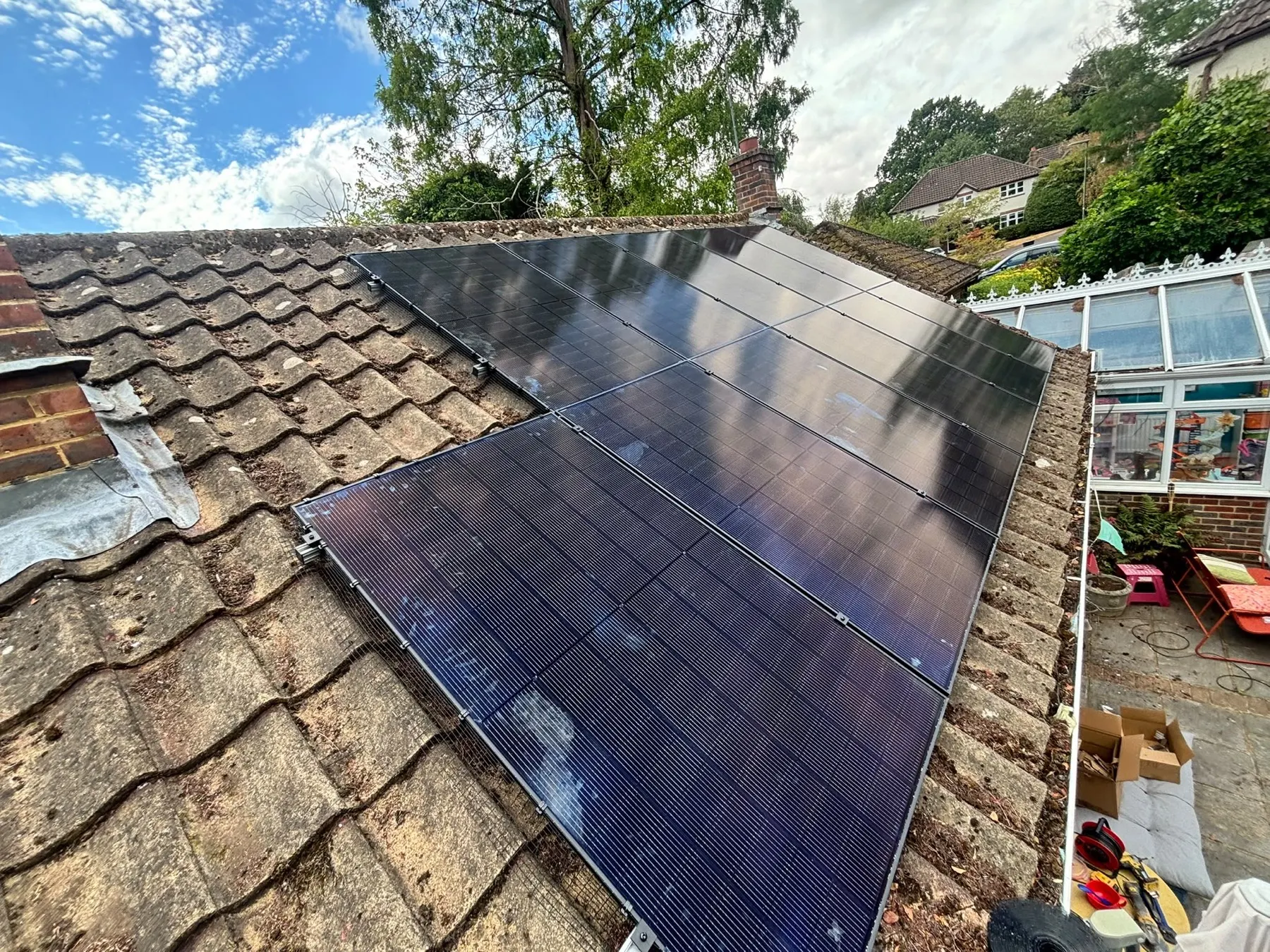 Farnham, Surrey
How much of the roof can be used.
Guildford gets around 1,675 hours of sunshine a year, which is a fair starting point but says little about one roof. What counts is the area free of dormers, chimneys and vents, the pitch and direction of each slope, and how much of the output the household uses.
That is why panel rating matters on tighter roofs. A higher-output panel lets a smaller usable area reach a worthwhile total.
Trees, neighbours and the shape of the roof.
Mature trees are part of what makes much of Surrey what it is, and they cast shade that moves through the year. We model it at the survey and, where it matters, specify equipment that lets each panel work independently.
Tall trees
Winter shade differs from summer shade, and growth can change it over the years.
Neighbouring buildings
Gables and extensions can shade a slope for part of the day.
Roof features
Dormers and chimneys cast their own shadows across nearby panels.
How the array will look.
For many Surrey owners, how solar looks matters as much as what it generates. All-black panels, even rows and concealed cabling are specified deliberately, and we show the layout before anything is fitted.
That matters most on street-facing roofs and in areas where appearance is judged more closely.
The Surrey Hills, conservation areas and listed buildings.
Most ordinary Surrey houses can have solar without applying for planning permission, provided the panels project no more than 200mm from the roof surface and sit beneath the ridge. The Surrey Hills National Landscape covers around 163 square miles, roughly a quarter of the county, and was an Area of Outstanding Natural Beauty until the 2023 rename. Conservation areas, such as those in Guildford and Farnham, and listed buildings are the other main exceptions.
Which applies depends on your exact address, and we look it up before a survey is booked.
In practice
Even in a protected area, a conventional roof array on a normal house can remain permitted development. Ground-mounted schemes, bigger or showier installations and listed buildings are the ones likelier to need consent, and we say early which group you fall into.
Listed buildings always require listed building consent, wherever they are, because any alteration needs separate approval.
Find out what your Surrey roof could support
Send the property address and a few notes on your electricity habits, and we will assess what the roof could support, planning included.
Free, with no obligation. Asking about payment options is not a finance application and will not touch your credit file.
There is no pressure to proceed. For a property in a protected area, we may raise the planning question with you first.